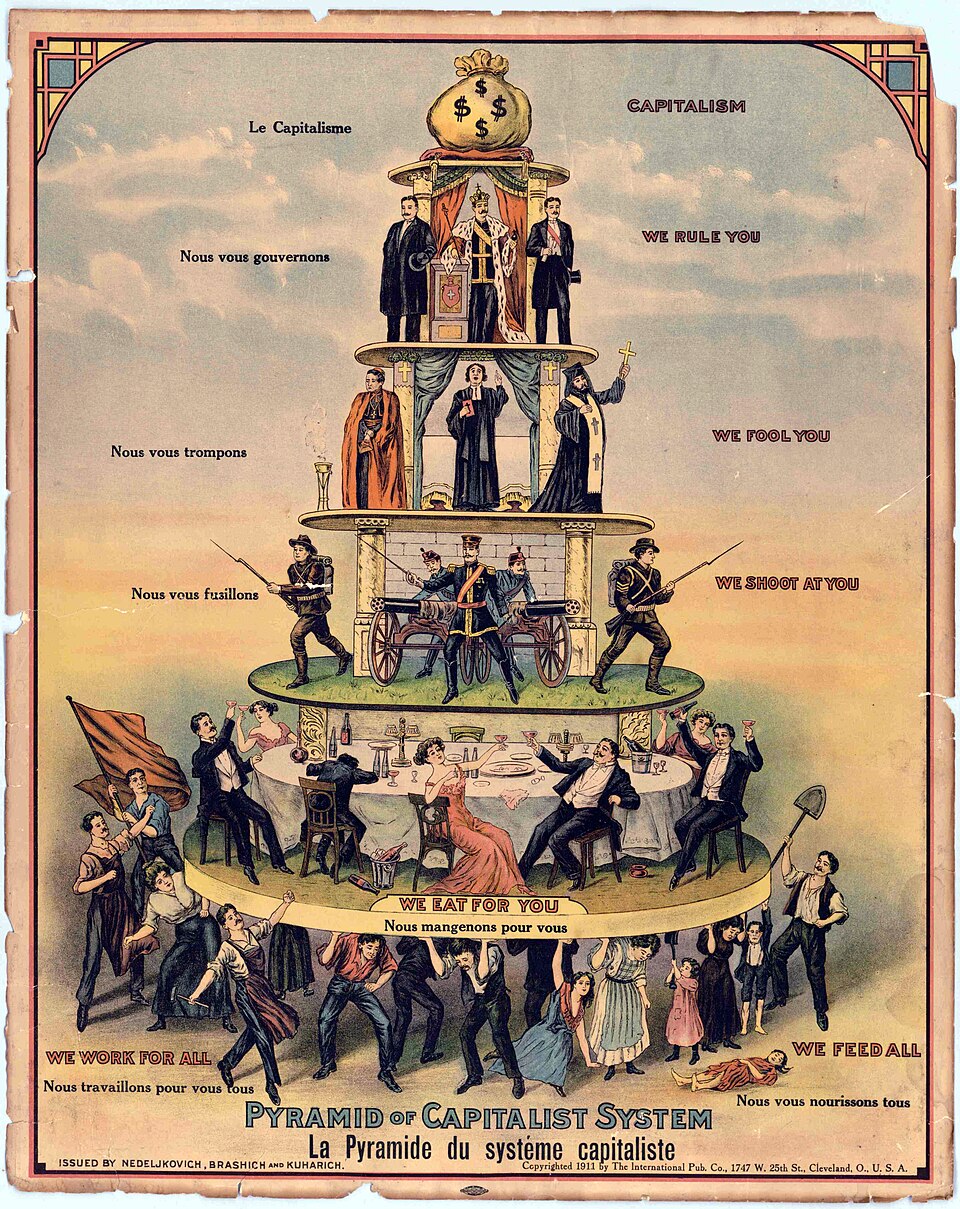
Extinction-level capitalism a citizen’s thoughts
on AI risk
AI is inherently political technology. If AI works as intended, it will gradually corrode our liberal democracy, risking an irreversible shift into another political and economic configuration. Among AI risks, this one deserves more consideration, because it requires no additional conditions like malign actors or AI malfunction. AI only needs to amplify existing trends, especially around concentration of capital. This damage will occur even assuming that in the near term, AI will broadly improve material well-being.
About MB
I’m a self-employed author, designer, programmer, and lawyer. In 2022, I learned that my own works were in the training datasets of generative-AI companies. In response, I invented the first set of lawsuits challenging the legality of these practices. I’m currently co-counsel for plaintiffs in a number of AI cases. Though I discuss certain legal issues below, I am not your lawyer, and nothing here is held out as legal advice. These are my personal views as a citizen and economic actor; I speak only for myself. This piece is typeset in Equity, Advocate, and Triplicate, fonts I designed. They can be licensed for your own polemics and pamphlets.
Emergent effects
Two billion years ago, the rock layers comprising what is now called the Colorado Plateau began to form: first igneous and metamorphic rocks, followed by many layers of sedimentary rocks. About fifty million years ago, through tectonic action, this plateau gained thousands of feet of elevation. About five million years ago, a river began to flow. The river carried silt and debris, scraping out the beginnings of a canyon. The river deepened the canyon, exposing its walls to weather and erosional forces that widened the canyon further. Today the waterway is the Colorado River. The geological formation is the Grand Canyon.

The formation of the Grand Canyon required zero human agency. Zero technology. Zero coordination among the river, the land, and gravity. In that sense the Grand Canyon is an emergent effect: a complex, unforeseeable output arising from simpler inputs.
But we would never wonder whether the river is sentient. Or whether the river cares about the dirt that it carries out of the canyon. The water is just doing what water does: flowing downhill. The dirt just happens to be in the way.
Inherently political technology
Langdon Winner is a political theorist. Winner wrote the excellent and influential essay “Do Artifacts Have Politics?” (1980). Winner sought to debunk the traditional framing that “technologies are … neutral tools that can be used well or poorly, for good, evil, or something in between.” Instead, Winner proposes two ways that a technology can affect its political environment:
The technology is designed to have certain political effects. For example, the Great Firewall of China, a bundle of technological measures that limit Chinese citizens’ access to foreign information sources. Antipodally, the Tor Project intends to maximize user anonymity and thwart government intrusion.
The technology is inherently political. This is Winner’s key analytic fulcrum. Winner describes two versions of inherently political technology. The first is where the technology “actually requires … a particular set of social conditions as [its] operating environment.” For instance, nuclear weapons: the only responsible way to possess such dangerous technology is to place it within “a centralized, rigidly hierarchical chain of command … the [atom] bomb must be authoritarian; there is no other way.” The second version is where the technology is “strongly compatible” with a certain political arrangement (even if not strictly required) and thus tends to bring that arrangement to fruition.

As an example, Winner considers the mechanical tomato harvester. Developed at UC Davis in the 1950s, the machine was tremendously productive. But it was also expensive. Only well-capitalized tomato growers could afford it. The rest couldn’t compete. According to Winner, the number of California tomato growers dropped from ~4000 in the early 1960s to ~600 in 1973, costing ~32,000 jobs and the compounding negative effects on those communities. Winner summarizes:
What we see here … is an ongoing social process in which scientific knowledge, technological invention, and corporate profit reinforce each other in deeply entrenched patterns that bear the unmistakable stamp of political and economic power … opponents of innovations like the tomato harvester are made to seem “antitechnology” or “antiprogress”. For the harvester is not merely the symbol of a social order that rewards some while punishing others; it is in a true sense an embodiment of that order.
Not merely the symbol—the embodiment. A facially neutral technological invention—here, a tomato harvester—can induce political effects. Those effects don’t arise from flaws in the technology. To the contrary—they arise from its efficacy.
How are the political effects determined? Winner identifies two key early decisions. The first is the binary question of whether to pursue the technology at all. The second are choices about “the design or arrangement” of the technology. Winner cautions: “[t]o see the matter solely in terms of cost-cutting, efficiency, or the modernization of equipment is to miss a decisive element”. That is, the political effects can possibly be countered, but first they must be acknowledged.
Of course, the best opportunity to choose wisely is before the technology is widely introduced, as capital and social investment tends to entrench it:
Because choices tend to become strongly fixed in material equipment, economic investment, and social habit, the original flexibility vanishes for all practical purposes once the initial commitments are made. In that sense technological innovations are similar to legislative acts or political foundings that establish a framework for public order that will endure over many generations. … The issues that divide or unite people in society are settled not only in the institutions and practices of politics proper, but also, and less obviously, in tangible arrangements of steel and concrete, wires and transistors, nuts and bolts.
Technological choices bear directly on the “public order” at large. When we don’t take those choices seriously—or we’re persuaded to ignore them by those insisting that technology is just a neutral tool—we risk political consequences.
Winner warns of complacency. Once the technology arrives and becomes entrenched, the conversation gets reframed as one of technological inevitabilism vs. anachronism, and dissent is discouraged: “the kinds of reasoning that justify the adaptation of social life to technical requirements pop up as spontaneously as flowers in the spring … After a certain point, those who cannot accept the hard requirements and imperatives will be dismissed as dreamers and fools.”
Liberal democracy
The balance of power of democracy is premised on the average person having leverage through creating economic value. If that’s not present, I think things become kind of scary.
—a certain AI CEO
Liberal democracy is the political scientist’s term for the type of government prevalent among capitalist economies since the American and French Revolutions. The intellectual foundation of liberal democracy arose during the Enlightenment, especially through the work of John Locke. Liberal democracy emphasizes limited government, individual rights, and separation of powers—in short, majority rule with exceptions and guardrails. (The term liberal democracy doesn’t connote liberals or Democrats in the specific US political sense. But political parties of differing ideologies are a traditional feature of liberal democracies.) Today, most liberal democracies are in Europe, the Americas, and the Pacific Rim.
Liberal democracy is not a fixed set of immutable characteristics, but a bundle of graded values. All liberal democracies emphasize certain ones over others. In the aggregate, some of these nations evolve toward stronger liberalism; others evolve away. These degraded cases have sometimes been called illiberal democracy: some formalities of liberal democracy may persist—e.g., multiparty elections, separation of powers—but the lived reality is single-party rule and declining individual rights.
That’s not to say that liberal democracy produces excellent outcomes for all citizens, all the time. It doesn’t. At any moment, certain citizens are dissatisfied—say, because they belong to a group that is politically disadvantaged or economically marginalized. Liberal democracy offers a process, not a result: grassroots democratic participation can coalesce into policy change. But within the arena of competing political interests, winners and losers necessarily follow. Navigating these differences within a stable, accommodative framework is preferable to a rigid one that buckles under these stresses—say, through political revolution, which tends to be messy and unpredictable.
Capitalism has traditionally been considered a necessary but not sufficient condition for liberal democracy. Why? A regulated market economy encourages citizen participation through property ownership and transaction. A principal function of government is to define the economic conditions of the state. Economic participation mutually reinforces democratic participation. Property owners will vote for those who protect their interests. The rise of industrial capitalism in the 19th century, and the wealth-redistribution mechanisms that followed in the 20th, led to economic empowerment for more citizens, and ultimately broader political empowerment. The converse also holds: economies premised on state or oligarchic control of some narrow class of assets haven’t tended to evolve toward liberal democracy.
In practice, certain people in a capitalist liberal democracy tend to get increasingly rich. Absent countermeasures, the wealthy gain control of the political apparatus, thwarting liberal-democratic norms. This tension between capital and politics is a long-considered topic. A key early work was, of course, Karl Marx’s Capital (about which more later). In the current era, Mancur Olson’s book The Rise and Decline of Nations set out how small groups with a shared interest (which could include capital concentration) can effectively undermine stable societies. More recently, economists Robert Reich (“How Capitalism is Killing Democracy”), James Galbraith (The Predator State), and Yanis Varoufakis (Technofeudalism: What Killed Capitalism) are among those who have studied the escalating political consequences of rising wealth inequality. The synthesis might be: as more wealth becomes concentrated in the hands of fewer citizens, liberal democracy weakens, because whichever citizens are losing economic relevance will also lose political relevance. A nation sending many of its citizens toward economic irrelevance risks becoming politically illiberal.
The Skynet fallacy
AI discourse often invokes sci-fi narratives. I’ve called this the Skynet fallacy, after the Terminator antagonist, the most cited. But any sci-fi will do. For instance, one AI CEO warned of AI “going Terminator”; Stephen Hawking and other scientists warned of AI “developing weapons we cannot even understand”; a second AI CEO said we “don’t need much imagination [about AI risk] because we grew up with that in the media”; a third AI CEO invoked the sci-fi movies Contact and 2001: A Space Odyssey in a piece about AI risk; a US congressman summarized AI risk as “evil robots rising up to take over the world”; a well-known journalist advocated for more Terminator analogies; a prominent AI-risk pundit said he’s “annoyed” with Terminator analogies yet has suggested that AI will eradicate humanity using hordes of toxic nanobots.

Artistically, sci-fi movies externalize the awe and unease of technological confrontation. It’s easy to see why these metaphors have become part of AI-risk discourse. And yet. As AI puts down roots in our economy, the sci-fi framing hides more than it reveals. Sci-fi plots are optimized for cinematic impact. As metaphors for AI risk, they can lead to faulty intuitions. Among realistic AI risks, we can expect that most will be boring, slow, and depend on minimal extra technology. Whether AI will cause literal human extinction is esoteric—a lightning strike. But AI could easily induce future economic and political conditions that most Americans today would consider intolerable—a cancer that extinguishes a certain way of life. Nobody’s going to make a movie about boring AI risks. But they comprise the majority of worrisome AI outcomes.
In 2003, philosopher Nick Bostrom proposed his now well-known parable of the paperclip maximizer. Bostrom imagines an advanced AI that is asked to make paperclips. Taking its mission seriously, the AI eradicates humanity as it consumes all Earth resources to make more paperclips. Bostrom was illustrating the AI control problem: ensuring an AI acts consistently with human priorities is difficult, even for ostensibly simple goals. Because when we say “AI, make paperclips”, the implied coda is “… without killing everyone.” But an AI can’t know this ex nihilo. Bostrom softens the sci-fi flavor by choosing paperclips and not, say, laser-wielding robots. Bostrom’s choice of an economic mechanism of resource conversion is apt. Even a mundane objective can produce outsize risk. We could further observe that on the paperclip-maximizing path, human life would become dystopic long before literal extinction. As resources are depleted, humans would become tenants in a neofeudalist paperclip empire. (Paperclip Crisis—opening soon.)
Computer scientist Stuart Russell also explored the control problem in his book Human Compatible. Russell calls one variant the gorilla problem: that “ancestors of the modern gorilla created … the genetic lineage leading to modern humans. How do the gorillas feel about this? … the consensus opinion would be very negative indeed.” Despite shared lineage, gorillas and humans have incommensurable values. Nothing humans can do—short of disappearing—would restore gorillas to their golden age. Russell’s framing is a believable analogy for the future relationship of humans and AI. Sure, gorillas didn’t deliberately invent humans. But I take Russell to mean that the emergent characteristics of these relationships are more consequential than the intended ones. (In that sense, Russell echoes Langdon Winner.) The fact that we’re inventing AI doesn’t mean we will predict or control its gravest effects. Any more than gorillas could predict or control human dominance of their ecosystem. The gorillas did their thing. We did ours.
AI will do its thing too. It will take time to figure out what that is, exactly.
How the West was won
I recently read Cadillac Desert by Marc Reisner, about the development of water resources in the western US between 1910 and 1980, especially the dam-building campaign of the federal Bureau of Reclamation. Reisner’s book weaves several storylines:
Engineering and environmental impacts. Dams concentrate water. But they cause environmental consequences elsewhere. Furthermore, Reclamation’s 20th-century projects were often based on optimistic projections of meteorological water supply. Today, long-term drought conditions challenge those projections. No amount of money or hydrologic engineering can change that.
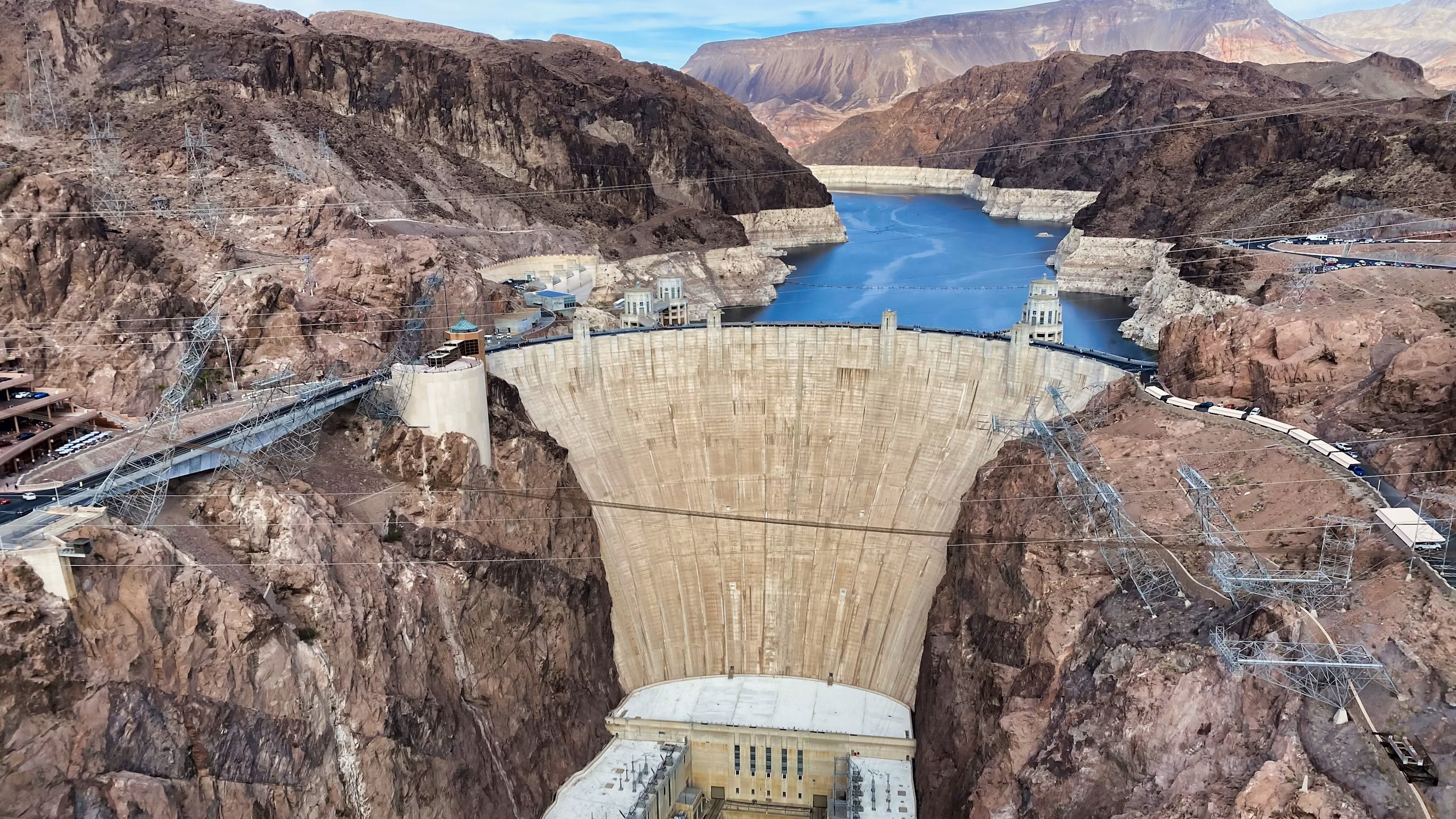
National US politics. In the early 20th century, newer Western states sought political clout in the federal government, which had been dominated by Eastern states. Political clout followed economic growth, and to achieve growth, the Western states depended on one critical but scarce input: water. In the West, Reclamation was tasked with increasing water supplies. A political symbiosis emerged: congressmen from Western states voted to fund Reclamation water projects; in turn, Reclamation looked out for their constituents. Reisner depicts this relationship as metastasizing over decades from practicality to corruption, with Reclamation becoming beholden to a narrow political lane. In that sense, Reclamation’s dams arguably qualify as inherently political technology.
State economies. Reclamation’s highly subsidized water bootstrapped Western economies, especially agriculture. For a while, it worked as promised: Farmers got irrigation. Cities got water. Western states grew and prospered. But the projects worked so well that Western states wanted more. These states never weaned themselves from subsidized federal water, setting them on a path toward permanent dependence.
The parallel between water and AI is inexact. Water is a biological necessity; AI is not. Reclamation’s projects worked (up to a point); AI may or may not. This is part of why AI proponents have sought to raise the stakes. So far, AI has been gruesomely expensive and delivered middling results. Nevertheless it’s routinely depicted as a geopolitical fulcrum, a proxy for continuing US exceptionalism. If Americans don’t adopt AI wholeheartedly, we will be losers. Do you want to be a loser?
Labor replacement
Q: What is Big AI primarily selling? A: Labor replacement, with mass unemployment as a likely consequence. Some disagree or call it doomerish. Why? It’s exactly what AI grandees have been telling us. A certain AI CEO wrote that AI “will be hugely destabilizing for hundreds of millions” and that AI tools “are fundamentally labor replacing”. A certain AI company released a research paper about “the labor market impact potential of large language models”. That AI CEO said “jobs are definitely going to go away, full stop”. A third AI CEO said that in the near future, “20% of people don’t have jobs.” A fourth AI CEO predicted that farther out, “probably none of us will have a job.” An AI-adjacent CEO said that AI “will destroy humanities jobs”. The ball is not hidden.

Capital markets are already pricing in these expectations. Regardless of whether Big AI eventually delivers mass labor replacement, today these companies seek to concentrate capital as if they will. According to the Washington Post, AI capital expenditure in 2026 is estimated to be $700 billion, a “spending spree [that] has few precedents”. Based on a recent survey of US workers, the Global Partnership on Artificial Intelligence said that “the policy window to shape how AI transforms work is probably closing faster than most governments realize.”
Extraordinary investment demands extraordinary returns. In early 2026, after a certain billionaire tech CEO laid off 40% of his employees and attributed the decision to a new “core thesis” of AI, the company’s stock rose nearly 25%. He won’t be the last. Whether these layoffs are based on actual AI benefits or merely “anticipatory” is neither here nor there. Employers have strong incentives to reduce headcount and increase AI spending before competitors do. We will increasingly see both kinds of layoffs. Software programmers are one set of consequential, highly paid writers likely to be replaced with AI. Elsewhere I’ve predicted that legal practice will also be seriously impaired. Why? Like programmers, lawyers write about consequential things and charge a lot. (We can expect that AI companies themselves, fond of dogfooding, will performatively set an example through their own AI-driven layoffs.)
Two common objections to this conclusion:
“AI won’t replace workers, it will enhance them.” That may turn out to be true. But for now, it’s not what AI CEOs are pitching. And it’s not how the market is valuing Big AI. AI customers will naturally pay less for a worker-assistive technology than technology that reduces headcount, which is one of the biggest expenses at any employer. The labor-replacement story is everything to everybody. If AI is just a neat way of, say, finding photos of your dog on your phone, none of the AI bets pay out.
“AI will replace certain jobs, but also create new ones.” Fair, but “create new ones” is skimpy on details. How do the jobs created compare to the ones lost? Do they pay more? Or less, as the supply of workers seeking work increases? Do the new jobs require different skills? Who bears the cost of the career switch? None of this is automatic. As economist Carl Benedikt Frey said: “Most economists will acknowledge that technological progress can cause some adjustment problems in the short run. What is rarely noted is that the short run can be a lifetime.”
After going hard on this narrative for several years, AI CEOs are now softening their tone, primarily in response to public backlash. For instance, the AI CEO who once said “jobs are definitely going to go away” now wants us to know that watching AI answer his emails felt “dehumanizing” and that he now values “the human part of the roles”. That’s what it finally took—using your own product? Ed Zitron has characterized the AI market so far as a blinkered conversation between AI executives and trad executives, all of whom “have little idea what work looks like”. This is more a feature than a bug. To replace labor, AI doesn’t need to actually deliver comparable outputs. It only needs to fulfill a certain executive fantasy of “what work looks like”. That’s much easier than, say, achieving AGI (however defined). On that view, AI may turn out to be a Veblen good—an item that buyers value primarily for signaling their ability to afford it.
One more small matter—funding of the US government is premised on employment. In 2023, the US got 48% of its revenue from income taxes and 36% from other payroll taxes. If AI causes 30% unemployment, revenues will drop and expenses will jump. Of course, higher unemployment also leads to lower aggregate consumer spending. These would be fiscal conditions unknown since the Great Depression, and utterly foreign to Americans living today.
The goodies economy
Big AI’s message to potential corporate customers of AI has centered on labor replacement. Correctly foreseeing that the workers themselves might take umbrage, Big AI has pitched them a separate story: that workers will enjoy higher standards of material well-being under AI.
One billionaire AI CEO predicted “universal high income” and that “AI and robots will provide any goods and services that you want.” Another billionaire AI CEO predicted “universal extreme wealth for everybody”. A billionaire AI venture capitalist “believe[s] in making everyone rich, everything cheap, and everything abundant” and that “the ultimate result will be that all physical goods become as cheap as pencils.” A tech billionaire predicted “more goods and services with less labor” and “always-available, high-quality medical advice.” Another billionaire AI venture capitalist predicted “the abundance of goods and services … will be very, very large. Prices will be very, very, low.” Hopefully yachts will come down too.
But wait—will they? In the post-AI economy, will we all have yachts? Of course not. As usual, we should be skeptical of billionaires. Especially those suddenly claiming to care about the purchasing power of workers. Are they fibbers or just fools? I think it’s more subtle: these billionaires are performing an idiosyncratic kind of class empathy, probably at the behest of publicists. This feeling doesn’t come naturally. So, like a cyborg reading a love poem, it’s stilted. The persistent lack of detail signals that these billionaires have no idea how, exactly, AI will accomplish this. But the subtext is clear: If tolerating worker purchasing power is what it takes to become a trillionaire, that’s a sacrifice I’m willing to make.
Sometimes this theory goes by fancy names like prosperity or abundance. Sometimes it’s linked to specific policy mechanisms like universal basic income. It all comes back to the same idea. I’m just going to call this stuff goodies. The theory is that under AI, citizens are going to get some nice level of goodies.

A few reasons we might be skeptical of AI-goodies theory. The price of any consumer good has a lower bound set by the cost of its inputs (if one is not selling at a loss). But labor is only one input. So even if AI reduces labor costs to $0, the cost of other inputs—e.g., energy and raw materials—remain. Even if AI lowers commodity prices by increasing their supply (say, through better discovery and extraction techniques), they are still rivalrous resources. Not all are available domestically. Postwar, rising global consumption of oil in the West influenced the formation of OPEC by future petrostates who sought to capture a share of oil-derived wealth. Similarly, in a post-AI US economy, foreign nations with critical minerals—e.g., lithium, cobalt, nickel—may likewise cartelize them, raising costs and creating a price floor. Related kinds of supply control may also arise domestically. Today, a certain US agriculture company uses patented seeds to exert control over a market of ostensibly independent farmers. If AI dramatically reduces the costs of manufacturing and agriculture, Big AI may seek to capture value from the factories and farms that benefit (say, through a sales royalty). AI-goodies theory implies that Big AI will allow maximum production of goods, leading to lowest prices. But the huge financial projections around AI—set by Big AI itself—may force them to do otherwise. That is, Big AI’s promises of world-historical goodies for consumers and world-historical profits for shareholders may be incompatible. If so—guess who prevails?
Still, to be fair to Big AI, I’ll accept their argument that citizens will enjoy higher standards of material well-being under AI through goodies. But the goodies must be paid for. Somehow, wealth must be transferred from Big AI to everyone else. These transfers can happen by three basic methods:
Direct. Big AI directly provides goodies to citizens. The “grand idea” of one AI CEO is to “capture much of the world’s wealth … and then redistribute this wealth to the people.”
Tax and spend. Government taxes Big AI at some high rate, and spends the money on public goodies. But the idea that American AI companies would consent to high tax rates to ensure public goodies is inconceivable because it vests more control in government, which no free-marketeer believes should be so.‡
Market-based. Big AI dramatically reduces the cost of goods and services, which then flow into the market at extremely low prices. The flaw in this method is that AI will reduce prices of certain things more than others. For instance, it’s easy to see how AI will make streaming movies free; food and healthcare and transportation, less easy.
These methods aren’t mutually exclusive. I expect the most likely method is the first, where Big AI directly provides the goodies, in the style of Gilded Age company towns. Big AI would avoid government intervention through taxation and redistribution. Big AI would control the goodies and who gets them. Big AI would get credit for providing the goodies. Assuming the massive profits materialize, Big AI could afford to make diverse baskets of goodies that include even things like food and healthcare and transportation.
Keep in mind that the goodies economy will play out against a backdrop of worsening AI-induced labor-market effects—high unemployment, but also wage declines, underemployment, misemployment, and so forth. Therefore, a side effect of the goodies economy is that whatever we think constitutes the social safety net will shift from a service of government to a service of private industry, specifically Big AI. One AI CEO shamelessly predicts exactly this outcome: that there is “opportunity for AI to be used to help provision government services … includ[ing] health services, the DMV, taxes, social security, building code enforcement and so on.” But don’t worry—he concludes that because “poorly implemented services” cause “cynicism about government”, AI intermediation would “strengthen[] respect for democratic governance.” And to be clear—by “AI”, he means “my privately owned AI”, and by “opportunity … to help” he means a massive government contract.
This portends a political shift. Citizens once treated government as a political bulwark against the encroachments and overreaches of industry. In the goodies economy, citizens will tend to align with Big AI, since it provides the goodies, which for many citizens may include basic needs. Under those conditions, if Big AI has a conflict with government—whose side will citizens take?
Industries have often insulated themselves against political consequences with popular products. Arguably, in the last 25 years, the tech industry—especially smartphone and social-media companies—has benefited from light regulatory scrutiny relative to its size. Examples from the last century include the automotive and fast-food industries, which likewise enjoyed decades of gentle regulation, even though both had serious public-health impacts.
To improve public acceptance, Big AI has so far emphasized their fun consumer-facing products. These products—e.g., generating an image, or writing a story, or riding in a driverless car—make AI seem harmless: the citizen thinks of their own usage as trivial and fun, and therefore models the aggregate effect of AI as a sum of similarly trivial individual usages. Consistent with this, Big AI has often framed these tools as “democratizing” (ex. 2, ex. 3) implying that opponents of these systems are in some sense anti-democracy (or as Winner predicted, antitechnology and antiprogress).
In the goodies economy, as citizens lose independence as economic actors, they will also lose independence as political actors. They will be captured by industry. Economist Yanis Varoufakis has called the current early stage of this arrangement “technofeudalism”, a term suggesting how late capitalism erodes individual economic agency. Through its provision of goodies, Big AI intends to complete this transition.
An economic historian might say that a political takeover by Big AI is unlikely, citing successful worker-led political movements in the US and Europe. If the US reaches 30% AI-induced unemployment, the thinking goes, workers will rise up and demand change through political mechanisms of our liberal democracy. There’s reason to doubt these parallels. These events occurred earlier in the technological era, when industry and workers were adversarial yet remained interdependent. Citizens retained irreducible leverage with both industry (as laborers) and government (as voters). In the decades after the US Gilded Age, this combination of economic and electoral power was critical to the rising status of workers. But in a future post-AI economy, workers could lose their jobs because of Big AI while remaining dependent on Big AI for basic needs. How do you bite the hand that feeds? Furthermore, many previous conflicts between industry and workers were not gentle adjustments, but violent (say, the Luddite movement of the 1810s, and Gilded Age strikes of the late 1800s) or caused devastating, permanent social transitions (say, the 1917 Russian Revolution).
Legally, shifting the social safety net from government to Big AI also means that citizen entitlement to these goodies will shift from public statutory and constitutional law to private-contract law. Private companies can withhold goodies for many reasons the government cannot. For instance: if you talk shit about the government, you will still get your unemployment check, because the First Amendment says so. But no such restriction on Big AI: if you talk shit about them, they will be free to revoke your goodies. Can’t happen? Already does: credit reports are a private system that largely controls who gets favorable interest rates. Or employer-provided healthcare, a structurally unnecessary tradition that distorts incentives for workers by making their continued health contingent on continued employment. Most likely, the political alignment between citizens and Big AI will not only be enforced by carrot, but also by stick.
Of course, an industry seeking to induce political alignment from citizens would benefit not only from distributing goodies, but also weakening the government. In 2023, would you have believed this prediction? That an AI CEO would endorse a presidential candidate. That the candidate would win. That on his first day in office, the new president would install the AI CEO in the government with broad powers, in pursuit of a nebulous project of cutting waste and saving money. That ultimately, this project would save little money and primarily impair government agencies designed to protect the vulnerable. That somehow the parts of the government that provided large contracts for the same AI CEO would remain untouched. To be fair, for centuries US businesses have sought to bend US public policy to suit their interests, often with great success. This is a theme of Galbraith’s book The Predator State. What’s new is the moustache-twirling flagrancy of the project, and that it was undertaken at the behest of the newly elected president. Some called it a coup, though one premised on abdication of power rather than seizure.
‡ As of June 2026, reporting has suggested that an AI CEO has proposed to the current US president that the US take an equity stake in the AI CEO’s company (and maybe others). This arrangement would be very different from taxation. It foresees a transfer of capital from the US government to the corporation to buy equity. As a shareholder, the US government would be entitled to a share of future profits, which may never exist. It also potentially creates a conflict of interest: as a Big AI shareholder, would the US govt regulate or legislate the AI industry? Taxation, by contrast, requires no prepayment by the US government, and can be assessed on the current activities of the AI company, regardless of profitability. Historically, the US government has taken equity stakes in private corporations as an indirect bailout. Which is maybe the better word for what is being proposed here. Absent this exigency, taxation is economically and politically preferable. This AI CEO may also want to ask his chatbot what happened to the oil industry in Venezuela under Chávez.
Know your enemy
Oh Karl, the world isn’t fair
It isn’t and never will be
They tried out your plan
It brought misery instead
If you’d seen how they worked it
You’d be glad you were dead.—Randy Newman “The World Isn’t Fair”
To identify as a Marxist today is rare (at least in the US). More often, it’s wielded as an anti-capitalist epithet against someone who endorses socialist or Communist methods. True—Marx himself supported these methods. After all, he did write The Communist Manifesto. But shorthand Marxism tends to omit the reasoning that Marx, a philosopher and historian, considered vital. After all, he did write Capital.
Marx saw class struggle as the key instigator of history. He argued that capitalism was politically unstable, and necessarily led to worker revolt. Marx’s theory that economic value originates in labor overlaps conceptually with Locke’s labor theory of property. But to Marx, capitalism separated—or using his preferred term, alienated—workers from the fruits of that labor.
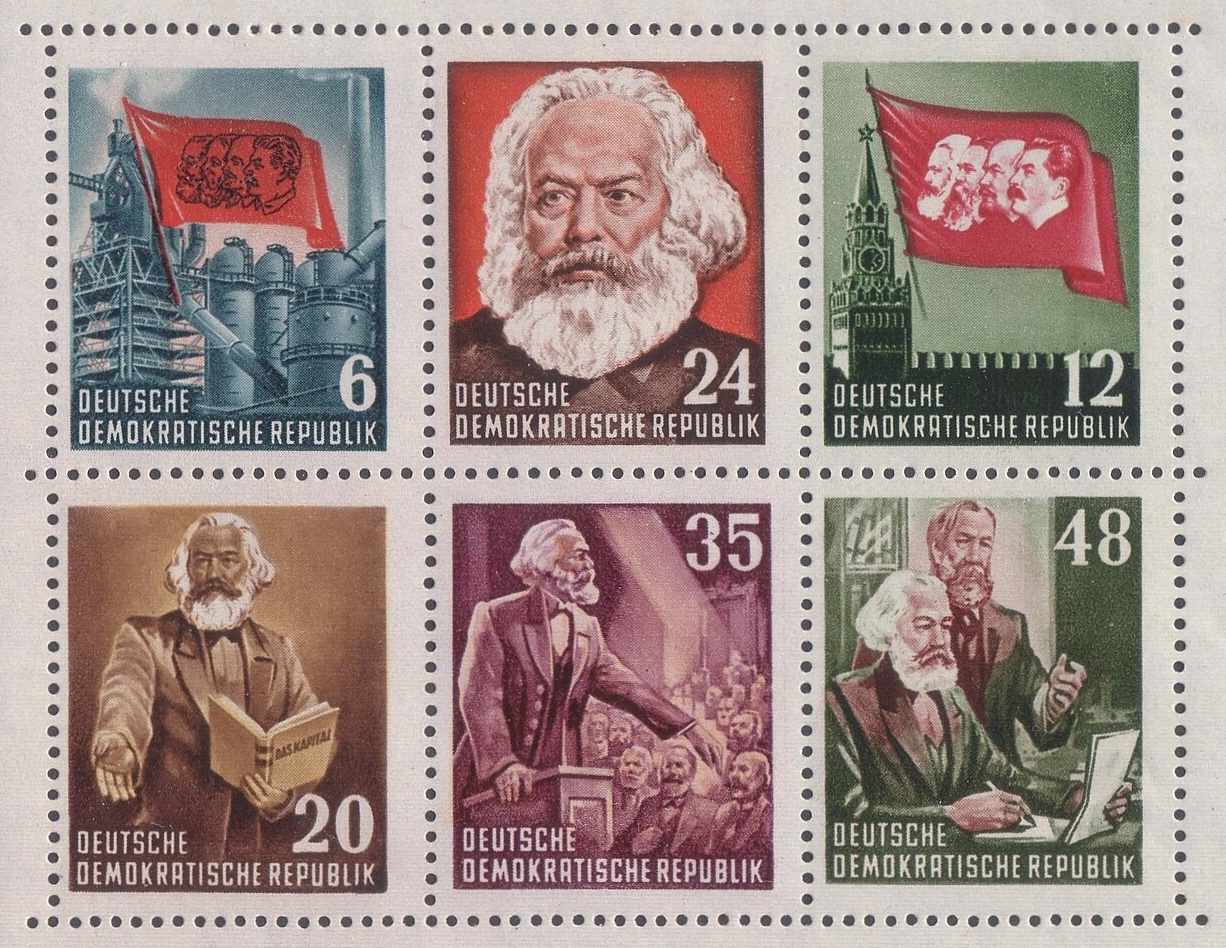
In practice, Marx’s theories have had mixed success. But Marx’s observations in Capital about the interaction of workers and machines remain relevant, even though he was writing in the mid-1800s, when the pinnacle of technology was textile machinery. Looking back on worker uprisings since the 1600s—including the Luddite movement that famously protested those textile machines—Marx wrote:
It took both time and experience before the workpeople learnt to distinguish between machinery and its employment by capital, and to direct their attacks, not against the material instruments of production, but against the mode in which they are used.
By protesting the textile machines, the Luddites were missing the bigger picture. The Luddites (and earlier workers) were raging against the literal machine—the specific new technology. But the technology was a symptom, not a cause. Instead, workers needed to rage against the bigger, figurative machine—the extractive capitalist system.
Marx’s observation has a subtler implication too. New technology often holds itself out as the starting point of a narrative: from now on, everything is different. When we consider the technology alone, that narrative dominates. But when we zoom out and consider the historical context, the new technology becomes the current endpoint of a much longer political narrative.
What would Marx say to AI critics—social, legal, economic, political—that have arisen so far? Maybe that we’re missing the bigger picture. That as a human invention, AI may be the starting point of a new technological narrative. But as an affront to human workers, it continues a long tradition of capitalist technologies, beginning with the Industrial Revolution (if not earlier).
For their part, the capitalists who own a new technology usually prefer to frame it as a starting point. Conveniently, this omits the grubby historical context that might dampen the marketing. Similar sleight of hand animates the snide techie’s favorite sick burn—Luddite—connoting a blockhead irrationally opposed to technology. Of course, this usage is deliberately ahistorical—read Brian Merchant’s Blood in the Machine. Perhaps there should be a companion term for a blockhead irrationally committed to AI.
These two frames for understanding new technology under capitalism also suggest two corresponding analytic approaches to AI risk:
AI as technology. On this view, AI is a starting point, and we consider the risks of what it can do that previous technologies could not. This isn’t wrong, exactly. It works for certain characteristics. For instance: I can believe that AI will facilitate hacking and similar criminality like no technology before. That risk is specific to AI as new technology and deserves consideration.
AI as capitalist instrument. But for other characteristics—say, AI’s effects on labor, public wealth, and the economy—thinking of AI strictly as new technology embeds the error Marx warns against. For those characteristics, we should consider how AI may amplify or accelerate existing trends. Put differently—the ways in which AI is inherently political technology.
In sum—as new technology, AI acts as a creator of new risks; as a capitalist instrument, it acts as an amplifier or accelerator of existing risks and trends in the capitalist system.
The strongest version of this framing is that the “amplifier or accelerator” part is precisely Why AI Exists. Unprecedented billions have already been poured into AI. Why? Because it’s expected to deliver more profit and concentrate more wealth than any previous technology. But amplifying these trends also means amplifying the attendant political risks. Earlier I accepted the argument that Big AI will deliver abundant goodies to citizens—which AI proponents consider one of the strongest points in its favor. But doing so will likely increase alignment between Big AI and citizens, with negative political consequences. As usual—no free lunch.
This shift in framing also shifts the evidentiary context. When we think about AI risk, we’re necessarily making guesses about the future. But when we frame AI in the narrow sense of new technology, we’re primarily considering a timeline that starts now. Whereas when we shift to thinking of AI as a capitalist instrument, we’re considering a timeline that starts centuries ago and has evolved continuously into the present. We can and should study those existing economic and political trends, because those will likely shape the future trajectory. Put differently: AI may be new. But it’s not immune to history.
The poisoned chalice
I think the biggest challenge to AI in this country is political unrest … Can you make more money? It’s all irrelevant if the country blows up … If I were sitting here in private with my peers, I’d be telling them … the country could blow up politically. And none of us are going to make any money when the country blows up.
—an AI-adjacent CEO
Big AI’s goal of labor replacement has two dimensions sometimes overlooked, although they are both hidden in plain sight. The first relates to AI’s effort to replace knowledge workers. The other pertains to the competitive effects of doing so.
AI replacing knowledge workers. Labor replacement is the mechanism. Structurally, Big AI seeks to build a moat around US economic growth by normalizing AI as a cognitive intermediary where knowledge work—roughly, economically valuable thinking and creativity—will happen.
This maneuver is part of the automation playbook, especially for the tech industry. During the rise of desktop automation in the 1980s and 1990s, tech companies sought to build moats by controlling the file formats, programs, and platforms where documents were created. As the commercial internet ripened during the 2000s, tech companies sought moats based on leveraging network effects—especially the unholy dyad of advertising and social media.
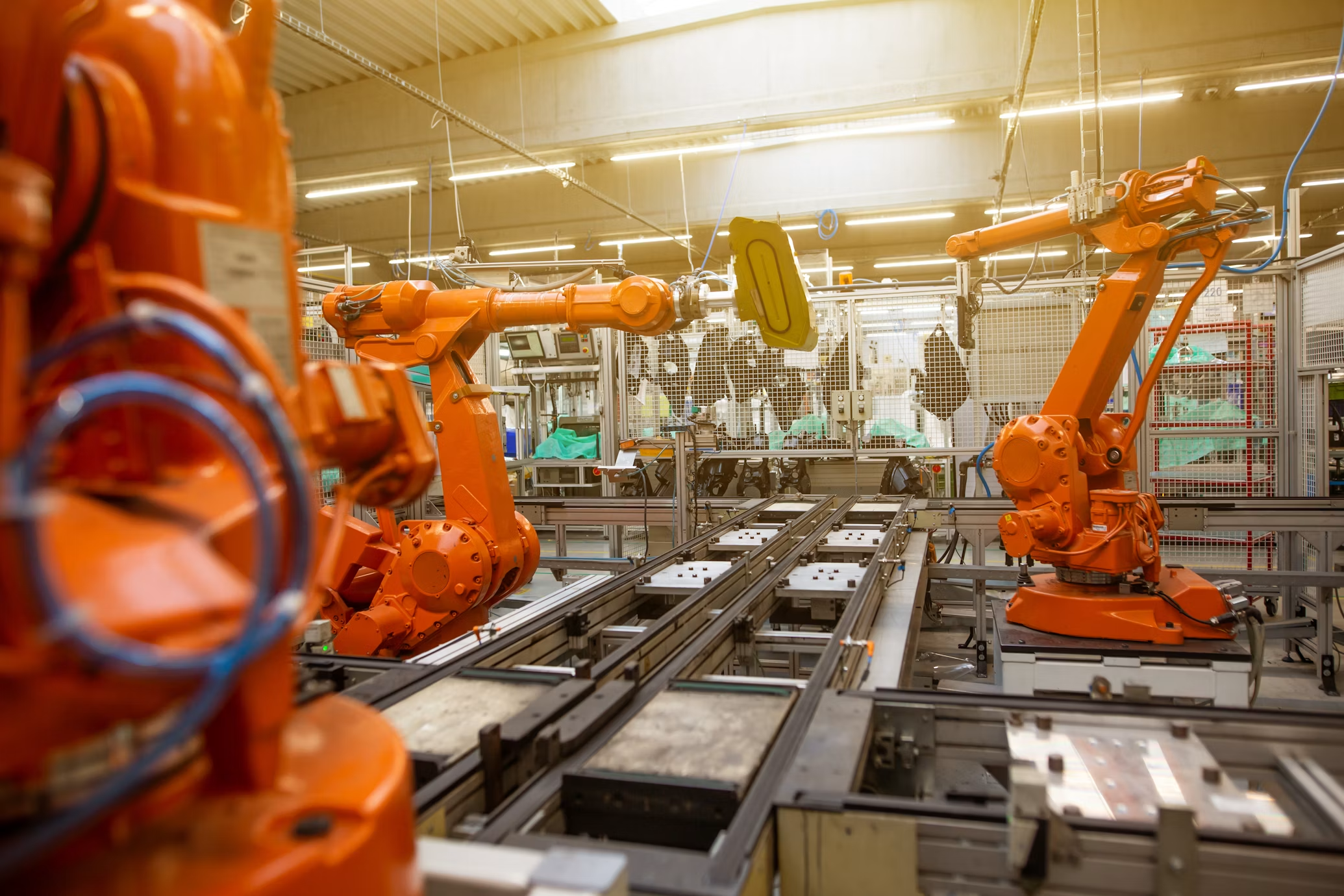
How Big AI plans to profit from this intermediation is an open question. One AI company has suggested taking a cut of AI-assisted discoveries. The logistics and legalities would be boggling. Details—whatever. For now, AI companies largely agree on the first step: make workers dependent on AI to do their jobs, just as tech forebears made workers dependent on a certain software program to share a file, or on a certain website to have friends. This time, however, the software ultimately consumes the worker.
Big AI’s timing is canny. In recent decades, intangible assets have played an increasing role in global economic growth. An intangible asset lacks physical embodiment, and includes formal intellectual-property assets (e.g., copyrights, patents) but also informal (e.g., brand goodwill, other knowledge-work assets). Tangible assets are the opposite—bricks, mortar, inventory, and so forth. According to the WIPO, since 1995 global investment in intangible assets has steadily increased, and since 2009 has exceeded that of tangible assets. By wide margin, the US leads investment in intangible assets.
For a long time, intangible assets were undervalued because traditional GDP measures and accounting practices excluded them. In the 1970s and 1980s, during the first big wave of IT investment, the US experienced a counterintuitive slowdown in productivity growth, an effect economist Erik Brynjolfsson called the “productivity paradox”. Part of the resolution to the productivity paradox is that returns from IT investment were manifesting not as labor productivity per se, but as intangible assets. For businesses, IT investment was worthwhile even if it didn’t increase labor productivity, because it still generated intangible assets. (Another part of the resolution to the productivity paradox is Brynjolfsson’s theory of lagging complementary investment, which will also likely apply to AI.)
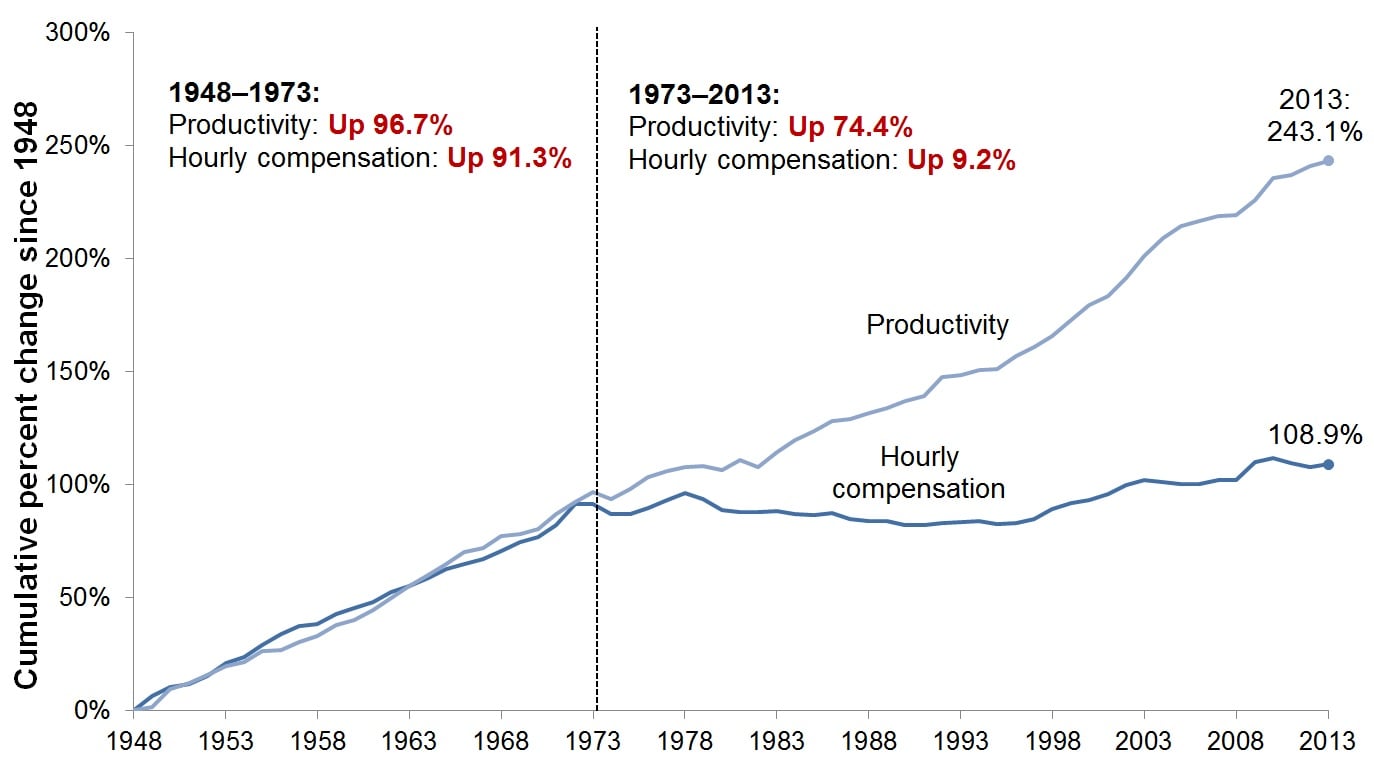
Nevertheless, increasing labor productivity matters a lot to workers. Why? It has historically been the biggest driver of wage growth. Which brings us to another—maybe the most—consequential trend in the US economy over the last 50 years: wage stagnation, or the decoupling of productivity and wage growth. As the story is typically told: from 1948 to 1973, wage growth (91.3%) basically matched productivity growth (96.7%). Since 1973, however, overall productivity has grown (74.4%) much faster than wages (9.2%). Where has the money gone instead? Into the pockets of business owners, mostly. Over the same timeframe, the operating profits of businesses (as measured by net operating surplus) has steadily increased. Today, if wage growth had kept up with productivity gains since 1973, we’d expect wages to be more than double.
Together, these trends have been a long-term double whammy for US workers. Because of wage stagnation, workers have been generating increasing value for employers (as productivity) but not capturing via wages the same share of that value they once did. Because of the shift toward intangible assets, employers have invested less in labor productivity, further inhibiting wage growth. As AI replaces knowledge workers, we can expect it to amplify both trends.
Will it? Recent labor-market research by one major AI company suggests that the greatest “theoretical capability” for AI labor replacement lies with traditional categories of knowledge work: finance, programming, engineering, science, legal, and the arts. A research group at Tufts University was blunter: “the more AI helps you do your job, the more expendable you can become. Finance professionals, teachers/professors, creative professionals, accountants and auditors, legal professionals” are at risk. Even Brynjolfsson said he was “surprised” that knowledge work would be so readily replaced.
“Technology always makes certain jobs obsolete; new ones will arise.” AI’s predicted labor replacement is unprecedented in three ways: the diversity of tasks replaced; its outsize effect on highly educated workers; and the backdrop of 50 years of wage stagnation. Automation-driven transitions aren’t necessarily easy, even when they’re narrow and the economy can absorb the workers. Those who handwave over the details should study historical examples. When you tell a large group of workers that their skills no longer have economic value, you risk a political and social tinderbox. Recall Carl Benedikt Frey’s comment: “the short run can be a lifetime”.
[
The competitive effects of replacing knowledge workers. The previous section considered how AI labor replacement will affect the relationship between workers and employers. But it will also induce more carnivorous competition among firms that adopt AI, and thus indirectly among the owners of capital. Whereas the last 50 years of the US economy have featured wage stagnation, the post-AI economy may feature something akin to capital stagnation, for non-AI categories of capital. A growing economy used to be a rising tide that lifted all boats. Post-AI, it may only lift a handful of yachts. Everyone else will be in dry dock. Arguably that capital transition is already underway.
How might this work? The economy is increasingly driven by intangible assets. Knowledge workers provide those assets. If a company lays off its knowledge workers in favor of adopting some vendor’s AI, at first it gets the same productivity at much lower cost. So much win.
But in doing so, the company commoditizes its own output. If your company can automate its output via AI, others can too. Your existing competitors, certainly. But also upstarts who don’t have your cost footprint. Whatever intangible assets AI can generate will be produced in excess, leading to a deflationary market for those assets. A company’s knowledge workers may be its greatest expense. But they also contribute to its competitive moat.
Furthermore, the ongoing market value of a company is necessarily tied to its differentiated assets. A company valued at a billion dollars that adopts AI will then have to build some new asset not replicable with AI, or it won’t be worth a billion much longer. Everything that makes AI an excellent cost collapser makes it an equally excellent capital collapser. A poisoned chalice. The greatest irony will be if AI-adopting companies—having laid off knowledge workers en masse—hire them back merely to ensure that competitors cannot. In recent tech history, there have already been signs of this dynamic.
Consider large law firms, aka Big Law. Currently certain legal-AI startups license LLMs from Big AI and repackage them for Big Law at high prices. These startups claim to add other special sauce. OK, sure. Where’s the economic equilibrium? If legal-AI startups prove that money can be made selling AI to Big Law—won’t Big AI just sell to Big Law directly, and cut out the startups? Or if legal-AI startups prove that AI can effectively provide legal services—won’t legal-AI startups just sell to clients directly, and cut out Big Law? Won’t members of Big Law that adopt AI have to lay off a lot of equity partners, because adoption of AI will shrink profit margins? Won’t the members of Big Law refusing AI have to consolidate to preserve their margins? Or just cave to AI? (The tendency of competitors to adopt similar practices is called institutional isomorphism.) So it goes. Most states prevent nonlawyers from sharing in legal fees, so law firms will probably remain a distinct set of entities. But one plausible equilibrium is that legal-AI startups disappear (quickly), and members of Big Law consolidate (relatively quickly) until there are only a handful left, all contracting directly with Big AI.
Along these lines, I expect that to succeed financially, Big AI will likely need to demolish a significant number of existing tech companies and grab their revenue for itself. By the process described above: Big AI essentially uses its tech customers as an R&D facility. Big AI licenses models to these companies. Tech companies compete to adapt their businesses to AI. Once a concept is proven, Big AI directly takes over that market. The labor-replacement story will grow into a company-replacement story. Many of those tech companies—and their shareholders in the public markets—may also find that AI is a poisoned chalice.
The resource curse
The theory is thought also to fit Middle Eastern oil exporters especially well. In this region, governments’ access to rents, in the form of oil revenue, may have freed them from the need for taxation of their peoples, and that this in turn freed them from the need for democracy.
—Jeffrey Frankel
Since AI is new, there are not yet examples of post-AI economies. So we might ask a broader question: what happens to nations whose economies are concentrated around one inherently political technology? The most instructive comparables in the world economy are probably petrostates: nations whose national wealth is concentrated in oil or natural gas. The analogy is imperfect. Unlike AI, oil is anchored to geography and limited in supply. On the other hand, oil has proven financial value; AI does not.

Petrostates are vulnerable to what economists call the resource curse, with two distinctive sets of effects:
Capital effects. The concentrated resource tends to pull labor and capital from the rest of the economy, depriving other economic sectors, especially manufacturing and agriculture. This makes the national economy more dependent on imports for basic needs, and more sensitive to price volatility of the resource. If the resource price declines sufficiently, the nation will be unable to keep affording imports, but also unable to fulfill those needs with domestic production.
Political effects. The value of the concentrated resource creates what Jeffrey Frankel calls “a political contest to capture ownership”, which in turn encourages the emergence of autocratic or oligarchic institutions captured by an economic elite who seek to retain control of the resource. The process is self-reinforcing in two ways. First: the economic elite uses its wealth to repress political opponents. Second: as the government derives more income from the concentrated resource, it relies less on taxation of citizens, which weakens democratic accountability.
According to the Council on Foreign Relations, “petrostates include Algeria, Cameroon, Chad, Ecuador, Indonesia, Iran, Kazakhstan, Libya, Mexico, Nigeria, Oman, Qatar, Russia, Saudi Arabia, the United Arab Emirates, and Venezuela.” No one would confuse this with a list of successful liberal democracies. Due to its increasing oil and gas production, some also consider the US a petrostate.
Which petrostates provide the most goodies to citizens? The Gulf petrostates—Qatar, UAE, Saudi Arabia, Oman. These nations distribute petrowealth to citizens through substantial public benefits (e.g., housing, healthcare, education, public-sector jobs) while having low rates of taxation. The tradeoff, of course, is that these countries are not even notionally democratic. They are hereditary monarchies. They offer none of the benefits that citizens in a liberal democracy enjoy (or sometimes take for granted)—democratic participation, individual civil rights, freedom of speech.
But the Gulf states were never liberal democracies. Can the resource curse send a liberal democracy spiraling into autocracy? Sure—consider Venezuela. Today, Venezuela is an authoritarian regime. But from 1958 to the 1990s, it was a stable liberal democracy. This changed with the 1998 election of Hugo Chávez. After taking office, Chávez pursued populist economic policies funded by national oil wealth. Emboldened by high oil prices, Chávez amended the constitution to bolster his own power and installed loyalists at the top of Venezuela’s national oil company (PDVSA). He redirected oil revenues to a series of domestic social programs (the “Bolivarian missions”). Chávez leveraged his resulting popularity among workers to consolidate his power, for instance by ending term limits and taking control of the judiciary. [
Norway is another outlier. Norway is a robust liberal democracy. After oil was discovered in its North Sea territorial waters in the 1960s, Norway created the state-owned Statoil to build and operate oil facilities. In 1990, Norway established the Government Pension Fund Global, a sovereign-wealth fund to receive surplus oil revenues and invest them for the benefit of Norwegian citizens. According to Norges Bank, “[t]he aim of the fund is to ensure that we use this money responsibly, think long-term and so safeguard the future of the Norwegian economy.” In one sense it has worked: the GPFG currently holds over $2 trillion in assets. What’s the problem? Even Norway hasn’t entirely avoided the resource curse. Rising sovereign wealth has delivered tons of goodies to Norwegians. But it has also made Norway’s government less financially disciplined and created social consequences like high dropout and unemployment rates. (A popular 2025 Norwegian book was called The Country That Got Too Rich.) Keep in mind that Norway reached this predicament despite 50 years of careful preparation and oversight. Inherently political technologies can upend even generational preparations. Those who would suggest that the US can follow a similar model with AI: easier said than done.
Extinction-level capitalism
Putting it all together: Among AI risks, we should take more seriously the potential consequences of AI working as intended. AI is a capitalist instrument. Its principal function is to concentrate capital. Its intended mechanism is large-scale labor replacement. But it is also inherently political technology. As AI makes it harder for workers to capture value from their labor, they will increasingly have to rely on goodies from Big AI, privatizing what were once functions of government. If Big AI subsumes the functions of workers and government, both will tend to realign politically around Big AI’s interests. Whatever term describes this system, it is not liberal democracy as US citizens have traditionally understood it. AI-centered capitalism risks an extinction of democratic possibility. It will be America. But it will no longer be American.
Epilogue
Thank you for reading.
Every citizen has a voice in these issues. Every citizen can participate in the vital public conversation about how we want AI to be part of our country—our schools, our work, our families.
Joseph Weizenbaum: “The myth of technological and political and social inevitability is a powerful tranquilizer of the conscience.“
In the upcoming election, vote for people who take your rights and interests seriously.
I support organized labor.
Ultimately, Big AI is constrained by an inconvenient truth. Today, they need us more than we need them. As long as that remains true, we the people have the upper hand.